
HDB Kitchen Tile Crack Repair Cost in Singapore (2026)

What you pay to fix a cracked kitchen tile in an HDB flat depends on three things: what caused the crack, how much floor or wall is affected, and what sits behind the cabinets. The tile itself is usually the cheapest part of the job.
This page doesn't quote prices, because a kitchen crack can be a ten-minute fix or a concrete repair, and nobody can tell which from a photo of one tile. What it does is show you what goes into the cost, so you can read a quote properly and spot a fix that skips the real problem.
What causes HDB kitchen tile cracks
Most cracked kitchen tiles come from everyday faults at the surface. A smaller number come from the concrete underneath, and that second group changes the whole job.
Impact, loose bedding and failed grout
These are the usual surface-level causes, and they are generally the simple ones to fix:
A dropped heavy item. A pot, a cleaver or a gas canister can crack a tile cleanly. If the tile around it sounds solid, the damage is local.
A hollow bed. If the tile wasn't fully bedded in adhesive or mortar, there's an air gap underneath. The tile flexes when you step on it and eventually splits.
Failed grout. Grout around the sink and along the wall lines cracks and shrinks over time. Water then gets under the tiles, softens the bed and lets them lift.
Movement underneath. A shifting screed or a crack in the floor layer can telegraph up through the tile above it.
A single cracked tile with sound tiles around it, and no staining at the joints, is normally a tile-level repair. You chip out the tile, re-bed it, regrout and seal.
The trouble starts when the cause isn't any of these. Water that keeps getting in will crack the replacement tile too.
Spalling behind kitchen cabinets: when the tile is only the symptom
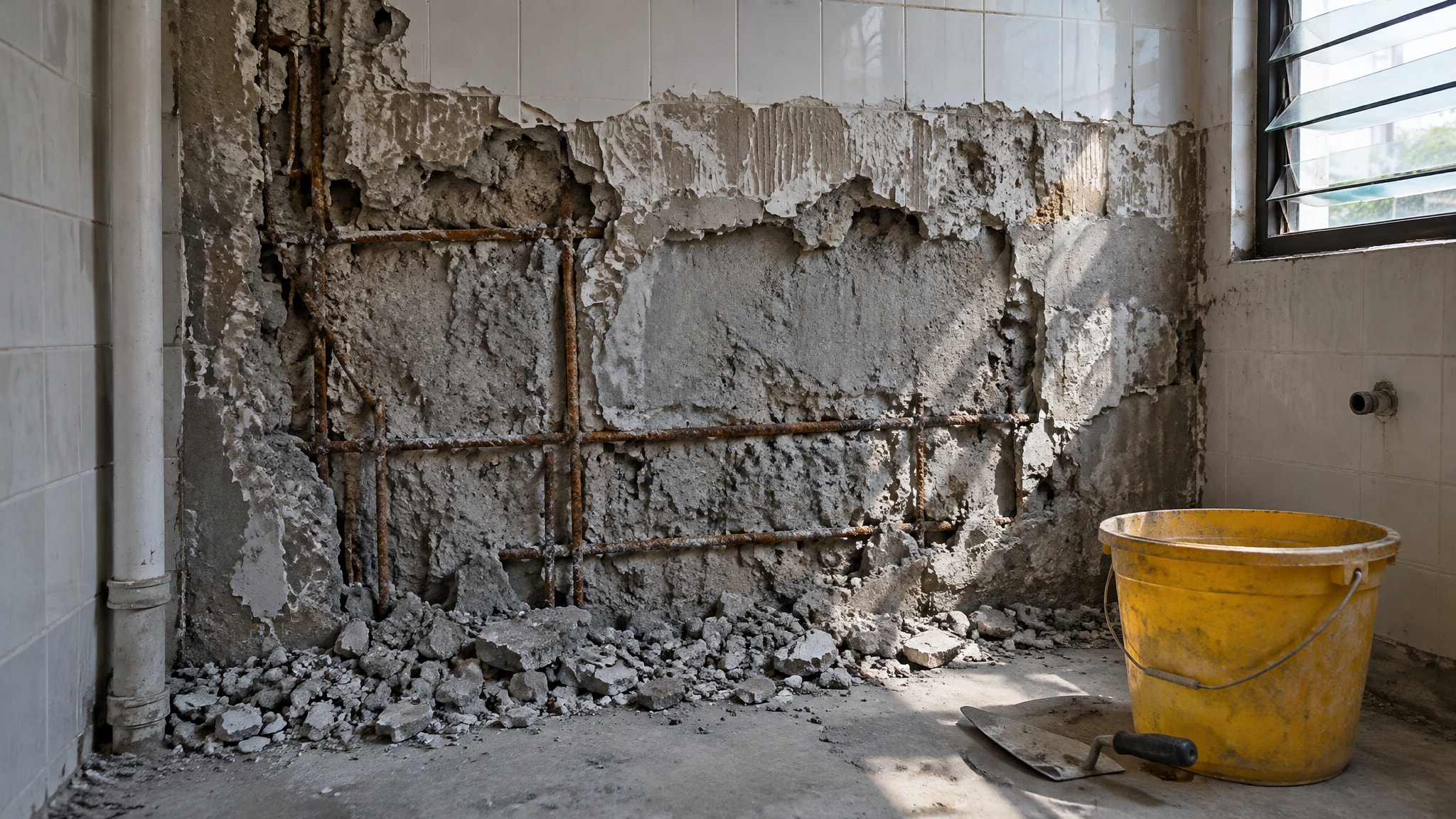
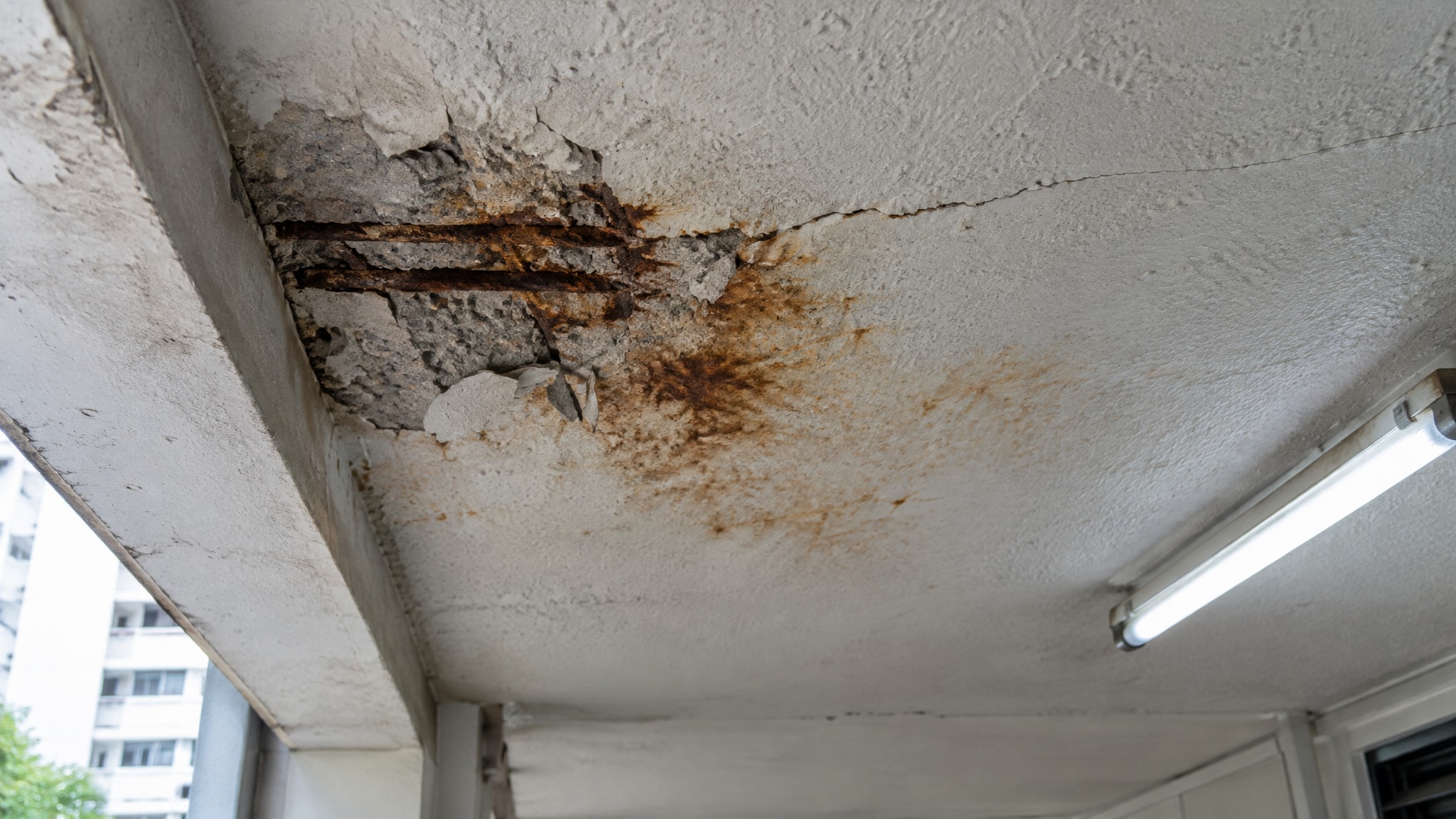
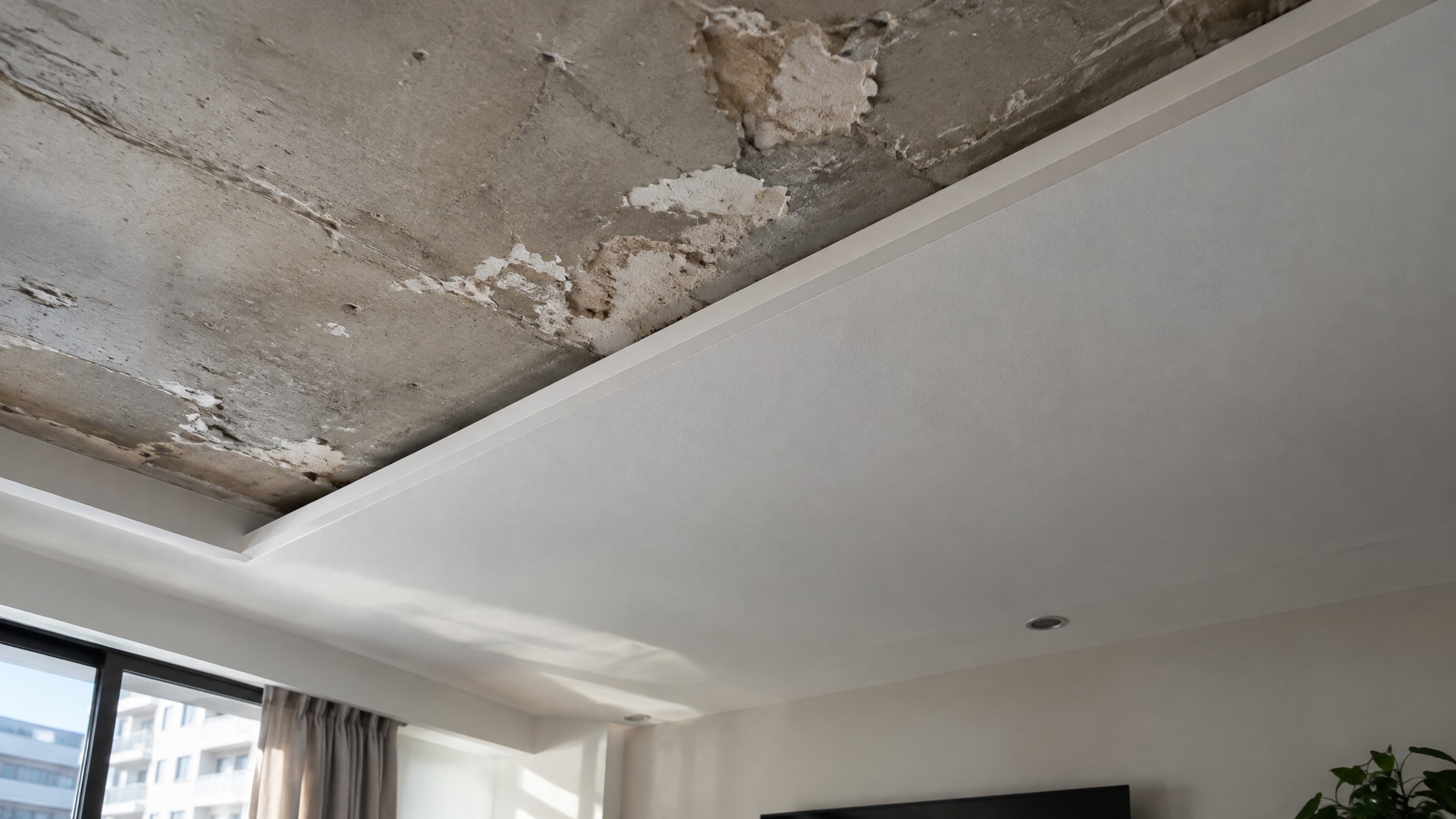
Spalling is concrete flaking off because water has reached the steel bar inside and rusted it. Rust takes up more space than steel, so it pushes the concrete outward until pieces break away. Tiles sitting on top crack and lift with it.
Kitchens are a common place for this because of sinks, pipes and wet cleaning. The catch is that base cabinets and countertops can hide the damage for years. By the time a tile cracks near a cabinet edge, the concrete behind it may have been deteriorating for a long while.
Treat spalling as a pattern to confirm on site, not a diagnosis you can make from a photo. Leng Painter's core work is spalling concrete repair across HDB toilets, kitchens, ceilings and outdoor areas, so a kitchen tile crack that traces back to concrete damage falls squarely within its specialism.
How to tell a concrete-linked crack from a surface crack
Start with a tap test. Run a knuckle or the handle of a screwdriver across the suspect tiles. A dull, hollow note where the rest sound solid means the tile has lost its bond to the bedding.
That alone doesn't prove spalling, because a poorly bedded tile sounds the same. So look for the other signs together:
Sound. Hollow over a wide patch, not just one tile.
Pattern. Cracks that run in a line or repeat across several tiles, rather than one random split.
Staining. Rust-coloured marks at joints or along the skirting.
Grout. Grout that cracks again after every repair.
Cabinet edges. Flaking, bulging or powdery paint and plaster where the cabinet meets the wall or floor.
A typical case looks like this: hairline cracks along one grout line beside the sink, a tile that sounds hollow when tapped, and a rust-coloured stain at the joint. One of those signs is a nuisance. All three together point at the concrete.
If you're seeing several of these, read up on the signs your HDB needs a spalling concrete inspection before you book any tiling work.
Why the concrete gets fixed before the tile
The order of work is fixed: concrete first, making good second, tiles last.
If the concrete is spalling, the loose material has to come out, the rusted steel bar has to be treated, and the surface rebuilt. Only then can a flat, sound base be laid for new tiles.
Retiling over the damage only hides it. The rust keeps expanding, the new tiles crack along the same line, and you pay for the tiling twice.
This is also how you keep the total down. Fixing the cause once costs less than repeated tile swaps that never hold.
What drives HDB kitchen tile crack repair cost
Every kitchen is different, so any figure quoted before someone has seen the space is a guess. What you can compare is the structure of the quote and the factors that push it up or down.
What a fair quote breaks down into
A comparable quote lists the work line by line. These are the lines you should expect to see:
Chipping out the cracked tiles and old bedding.
Re-bedding or making good the base so it's flat and sound.
Tile and adhesive, whether new or matched to the existing ones.
Grout and sealant, including sealing at the sink and wall joints.
Making good any surfaces disturbed by the work.
Debris removal, so you aren't left with a bag of broken tile and dust.
Cabinet work, if units have to come out and go back.
The spread runs from one tile swapped with no other disturbance, up to cabinet removal plus concrete repair plus retiling a whole section. Those two jobs share a cause category, a kitchen and a cracked tile, and almost nothing else.
If the crack does turn out to be spalling-linked, the job is priced as a concrete repair first. It helps to understand how spalling repair packages are priced so that line doesn't come as a surprise.
Kitchen-specific drivers: cabinets, sink and hob, and tile matching
Bathroom tiling pages rarely cover these, and they can outweigh the tile itself.
Cabinets and countertops. If the damage runs under or behind them, they have to be removed and refitted. That's labour and, sometimes, a separate trade.
Sink and gas hob. Disconnecting and reconnecting a sink or gas hob has to be done by the right licensed trade. Don't let a tiler improvise it. That work is a cost line of its own.
Tile matching. If your tiles are no longer made, a close match may not exist. When that happens, a patch looks obviously wrong and the sensible fix is to redo a wider area, which raises the cost.
Tight work areas. HDB kitchens are small. Limited room to move, carry out debris and work around fixed fittings adds time.
Your cheapest repair is the one where the cause is simple, the tile can be matched and nothing needs to be moved. Anything outside that adds lines to the quote.
Patch or replace: kitchen tile replacement cost in HDB flats
A patch costs less up front, but it only works when the conditions are right. Where they aren't, a patch is money spent on a repair that fails.
Patch when all three of these hold:
The crack is isolated to one or two tiles.
The bed underneath is sound.
A close tile match exists.
Retile the section when cracks cluster, when several tiles sound hollow, or when no match can be sourced. That's when kitchen tile replacement cost in an HDB flat rises, because you're paying for more tile, more chipping out and more making good.
Wall tiles follow the same rule, with one addition: if the cracked tiles sit behind or under cabinets, those come off first.
Floor cracks need the screed underneath checked before anyone lays a new tile. A new tile on a weak screed will crack again.
If you also have cracks in the bathroom, the bathroom tile crack repair guide covers the same steps for a wet room.
HDB kitchen floor tile repair: when one patch is enough
For HDB kitchen floor tile repair, one patch is enough when a heavy item caused the damage and nothing else is wrong. Check the surrounding tiles by tapping. If they're solid and the grout is intact, swapping the one tile is a sound repair.
Be wary of a patch near the sink, along a wall line, or beside a cabinet base. Cracks in those spots usually have water behind them, and water is the part a patch doesn't fix.
A patch also won't help if the bed is hollow across a wide area. That isn't a cracked tile problem. It's a bonding problem, and it needs the section lifted.
How to choose a cracked tile repair contractor for a kitchen job
You want someone who looks at what's under the tile, not just the tile. A tile-only quote can miss a concrete problem completely, and you find out when the new tile cracks.
Our guide on how to pick a kitchen tiling contractor has the full checklist. If any of the signs above showed up, also read about a contractor or handyman for spalling-linked cracks, because the person who diagnoses the concrete matters as much as the person who lays the tile.
Ask these before you agree to anything:
Will you tap-test the surrounding tiles and check the cabinet edges?
What happens if concrete damage turns up once the tile is off?
Can you source a matching tile, and what do you do if you can't?
Who handles the sink or gas hob if it has to be disconnected?
A contractor who answers these plainly is worth more than one with the lowest number on a page.
What a written quote should spell out
Get the scope in writing, area by area, not one lump sum for "kitchen tiles". It should cover:
Scope per area. Which floor or wall sections are included, and which aren't.
Tile sourcing and matching. Where the tile comes from, and what happens if no match is found.
A stop-and-confirm rule. If concrete damage shows up, work stops, you're shown the damage, and a separate line is agreed before anything continues.
Cleanup. Debris removal and a clean finish.
Workmanship warranty. What's covered and for how long, stated in the quote itself.
That stop-and-confirm rule is what protects you. Without it, a tile job can turn into an open-ended concrete job with no agreed price.
When HDB or insurance may help with a kitchen tile crack
Whether anyone helps with the cost depends on the cause and on who is responsible for the affected wall or floor, not on the tile. A tile cracked by a dropped pot is a household repair. A crack caused by a fault in a part of the building you don't own is a different conversation.
We can't promise any cover. Check your own home insurance policy wording, and ask HDB about the specific location of the damage, because responsibility differs by element.
If your crack is linked to spalling, the spalling concrete grant and subsidy guide explains what may be available. It applies only to spalling-linked damage, so don't assume a plain tile crack qualifies.
Kitchen tile repair in Singapore: how to book an assessment
The fastest way to get a straight answer is to send photos. You'll need:
The cracked tiles, close up and from a step back.
The wall or floor they sit on, including any stains or flaking nearby.
Any cabinets or appliances fitted over or beside them.
Those photos tell us whether this looks like a surface job or a concrete one. They don't settle it. Only a site visit, with a tap test and a look at the cabinet edges, does that.
Leng Painter will then arrange an on-site assessment and give you a written quote that lists the work line by line. We won't give you a figure before we've seen the kitchen, because a number that early would be a guess.
Comments