
HDB False Ceiling Vs Plaster Ceiling Repair: Which to Pick

A stained or flaking ceiling in an HDB flat leaves you with one real decision. You can repair the exposed plaster or slab, or you can hide the damage behind a new false ceiling.
Both routes can look fine on handover day. Which one still looks fine two years later depends on the water, the concrete and what you need to hide up there. We do plastering, ceiling repair and spalling concrete repair in HDB flats every week, and this comparison comes from that work.
HDB ceiling options: what each one involves
Most online comparisons pit plaster against drywall in older landed houses. An HDB flat is different. Your ceiling is usually a concrete slab, and the real question is whether to repair what you can see or cover it.
Plaster ceiling repair means working on the existing surface. We find loose or hollow plaster, remove it, treat the cause, then patch, skim and repaint. The slab stays visible and open to inspection.
A false ceiling means a new layer hung below the slab on a frame. The panel can be gypsum board, PVC or aluminium. It hides the old damage, and it can also hide pipes and wiring.
How to tell which one you already have
You can usually tell without opening anything up.
Tap test. Knock with your knuckle. Plaster over concrete gives a dull, solid sound. A board false ceiling sounds hollow, almost like a drum.
Wall edge. A false ceiling often drops below the original slab level. Look for a step, a shadow gap or a cornice strip where ceiling meets wall. A plaster ceiling meets the wall in a plain line.
Seams. Gypsum board shows joint lines, filled screw heads or fine cracks in a straight grid. PVC and aluminium show regular grooves or strips. Plaster over concrete has no grid.
Access panel. A square hatch, often near the water heater or a light point, means there is a void behind it.
If the tap test is unclear, the access panel settles it.
Find the water source before you choose
Neither option is worth paying for until you know whether water is still getting in. A new board or a fresh coat of paint over a live leak is money spent twice.
Start by reading the stain. A mark that grows, darkens after showers or dishwashing upstairs, or comes with fresh drips and damp edges points to a live leak. A dry, old mark with a clear edge may be a past leak or just condensation.
Take a dated photo of the stain every few days, and again after heavy water use. Those photos tell you whether it is changing, and they give you something to show whoever owns the source.
Here is a typical case. A toilet ceiling stain gets darker after the family upstairs showers in the evening. The owner repaints twice and the mark comes back. In the end the cause is a pipe joint above, not the ceiling at all.
Leaks from the flat above
The source is often in the unit upstairs: a pipe, a joint or a cracked floor in their toilet. You cannot fix that from your side, so talk to the owner early and show your photos.
Once the source is stopped, give the ceiling time to dry out. Repairing a damp surface only brings the problem back.
If a false ceiling is already up, you cannot judge the damage from below. Ask for an inspection opening and look at the slab before deciding what happens next, because the board in front of you may be hiding a very different story.
Plaster ceiling repair in Singapore: when patching is enough
Plaster repair works when the coat is still firmly bonded to the slab and the water has stopped. It is a surface fix for a surface problem.
It does not fix a leak, and it does not make a damaged slab sound. If the problem is deeper than the plaster, patching only delays the real repair.
Surface damage a patch can fix
Tap the ceiling lightly across the stained area and a little beyond it. Solid sound means the plaster is still bonded. Hollow patches mean it has lifted.
The sequence is simple. We chip off the loose plaster until we reach sound material. After the water is fixed, we patch, skim and paint. Where mould sits on plaster that is otherwise sound, a mould-resistant paint finish helps once the surface is clean and dry.
How deep the mould goes decides what comes next, and we cover that in mould treatment or full re-plastering. If you are choosing between finishes, see plaster versus skim coat on HDB ceilings.
Patches can show at the joins, and in some lighting you may see a faint outline. That is normal for spot repairs, and a wider skim coat reduces it.
A bare slab exposed after an old false ceiling is removed gets the same tap check and the same prep before anything goes back up.
When the concrete slab is spalling
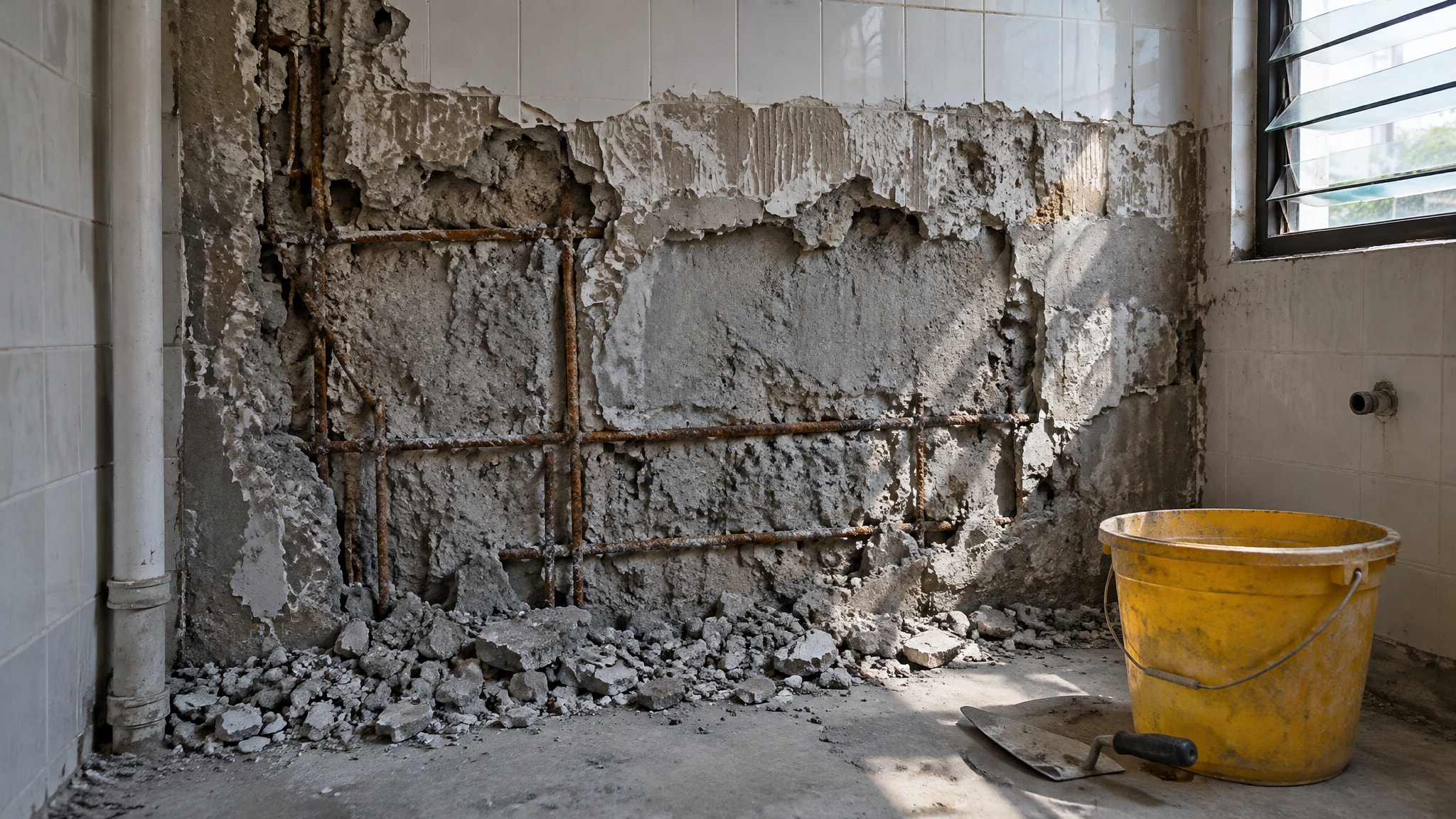
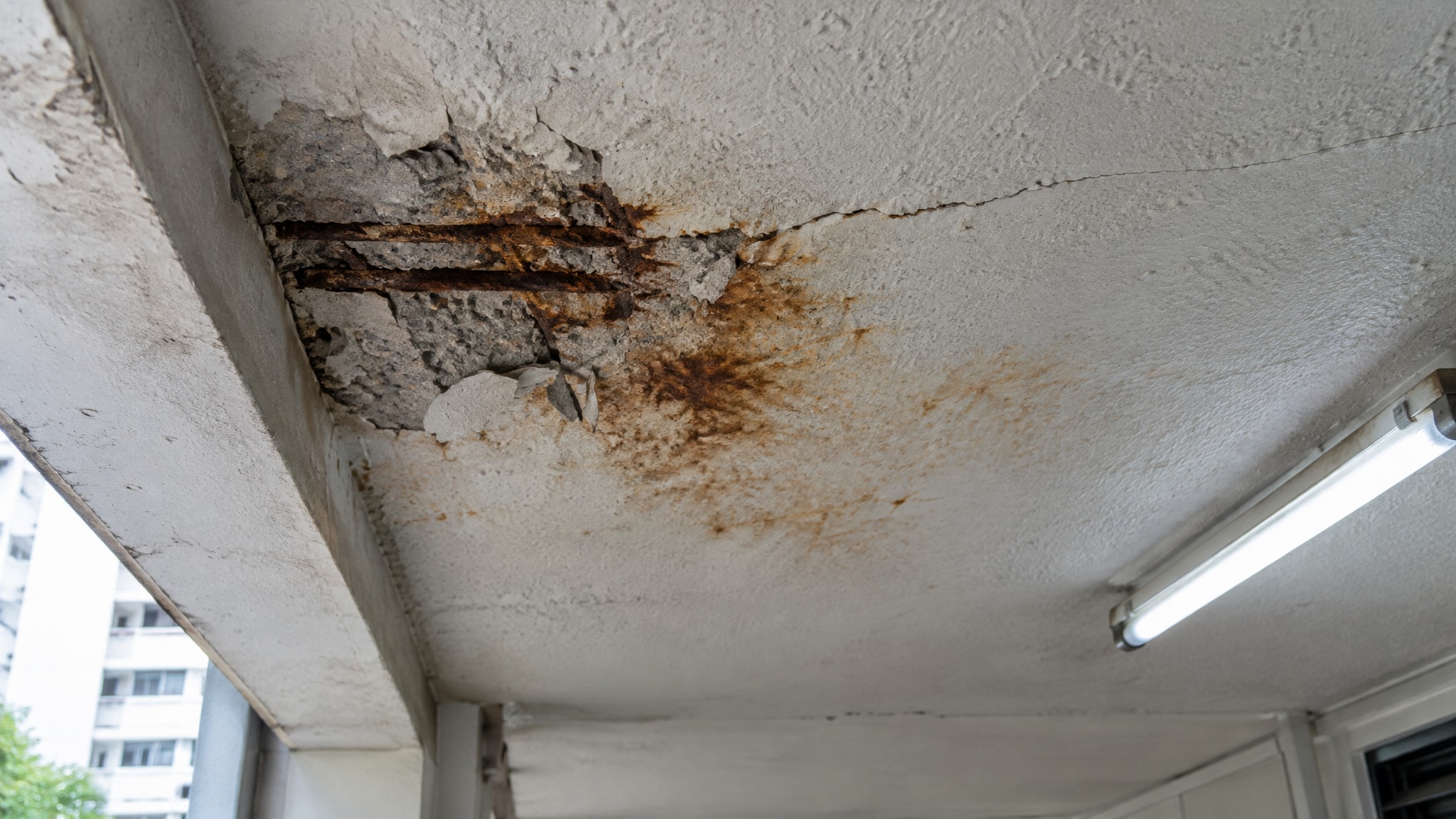
Some damage is not plaster at all. Watch for these signs:
rust-coloured stains on the ceiling
exposed rebar
cracking along the soffit, the underside of the slab
concrete that sounds hollow or drops in pieces
Any of them means the concrete needs repair first. Standard practice is to chip back the unsound concrete, treat the exposed steel, then rebuild the surface. A board or skim over rusting steel only hides the damage, and the corrosion keeps running behind it.
Our guide on signs your HDB slab needs a spalling inspection lists what to look for before you decide.
False ceiling leak problems: what the board hides
A false ceiling over a live leak hides the stain, not the water. The leak keeps going, and you lose your early warning.
How a live leak travels behind the board
Water does not stay where it enters. It tracks along pipes and joists and drips off the lowest point, which may be metres from the source. By the time a stain shows on the new board, the void behind it may already be wet.
Gypsum board has a paper facing and a soft core, and both weaken when soaked. It sags, and mould can grow on it if it stays damp. PVC, aluminium or moisture-resistant board copes better in wet rooms, though none of them makes a leaking void safe.
The result is a harder job later, because anyone tracing the leak has to open the ceiling first and then work out what is wet and for how long.
Access, wiring and wet-area board choice
If you do put up a false ceiling, plan for four things.
An access panel. You need a way to reach pipes and wiring without breaking the board.
The right board for the room. In toilets and kitchens, choose PVC, aluminium or moisture-resistant board over standard gypsum.
A licensed electrician. Any relocated lights or fans must be done by one.
Permits. Check whether your work needs an HDB renovation permit before it starts.
Ask your contractor to put these in the quotation in writing.
Cost comparison: false ceiling repair in HDB vs plaster repair
Compare scope, not the headline price. Two quotes can look far apart and still cover very different jobs.
A small plaster patch is usually the cheapest route, because it is mostly labour and material for one spot. A false ceiling adds framing, boards, jointing, paint and sometimes electrical moves, so on a large area it can cost about as much as a full re-plaster. For the plaster side, see what HDB plastering typically costs.
A quote that skips the leak fix or the concrete work is not cheaper in the end, because you pay again when the damage returns. If you have two or three quotes in hand, how to compare toilet ceiling quotes line by line shows what to check.
What moves the price
Area. A single patch costs far less than a whole ceiling.
Depth of damage. Loose plaster is quicker than spalled concrete with rusted steel.
Leak work. Tracing and stopping the source may sit outside the ceiling quote, so ask who is handling it.
Board type. Wet-area boards cost more than standard ones.
Electrical moves. Relocating lights or fans adds licensed labour.
Access and finish. An access panel and the final paint are small items that quotes often leave out.
Durability: how each option holds up over time
Plaster lasts well once the water is stopped and the prep is done properly. Patches can still show at the joins and may re-crack if the slab underneath moves.
A false ceiling has two weak points, the board and its joints in damp rooms. Both suffer first when humidity stays high or a pipe weeps. The hidden void is the bigger issue, because problems there last longest before anyone sees them.
For either option, moisture matters more than the material. If the water is stopped, both can last. If it is not, neither will, and you may not find out which until the damage has spread.
Ceiling repair decision guide for HDB flats
Here is how the two routes compare side by side.
Visibility of damage: Plaster repair: Slab stays visible and easy to inspect, False ceiling: Hidden behind the board
Cost direction: Plaster repair: Lowest for small areas, False ceiling: Rises with framing, boards and electrical work
Disruption: Plaster repair: Dust and short patching jobs, False ceiling: Framing, boards and possibly wiring changes
Durability: Plaster repair: Long-lasting once dry and sound, False ceiling: Depends on board and joints in damp rooms
Work through it in this order. First, stop any live leak. Then check the concrete. Only after that pick the finish.
Choose plaster repair when the surface is the only problem
Pick plaster repair if the slab is sound, the water is stopped and the damage is cosmetic: flaking paint, a stain, a small patch of lifted plaster. It is the simplest fix, it keeps the slab open to inspection, and it usually costs less.
Choose a false ceiling when services or renovation drive the job
A false ceiling makes sense when pipes, wiring or a renovation layout need hiding, and the surface above is dry and checked. It also suits a reno where you want recessed lights. It is not a cure for a leak or for spalling, so sort those out first.
If you are not sure which side of the line your ceiling sits on, send us photos and tell us what you have noticed. When you know whether the leak is fixed and which route fits, you can request a ceiling repair quote and we will tell you plainly what the job needs.
Frequently asked questions
Why would you use plaster instead of a false ceiling or drywall?
Plaster repairs the surface you already have, so the slab stays visible and easy to check for leaks or rust. It usually costs less on small areas because there is no framing or board. It only suits ceilings where the concrete is sound and the water has been stopped.
Is plasterboard the same as gypsum board?
In everyday use, yes. Plasterboard and gypsum board both mean a gypsum core with a paper facing. Drywall is another name for the same product. Moisture-resistant types exist, but none of them tolerates a leaking void.
What does a plaster ceiling look like?
A plaster ceiling over concrete is a smooth, continuous surface with no joint lines or screw marks. It meets the wall in a plain line, without a step or cornice. It sounds dull and solid when you tap it.
How can you tell the difference between sheetrock and plaster?
Tap it. Plaster over concrete sounds solid, while board sounds hollow. Look for straight seams and filled screw heads, which show board. An access panel gives you a look at the void and the board edge behind it.
Comments